You can’t win if you don’t play. If you buy a ticket, at least you have a chance. Is that chance worth it, though?
The chance of winning the Powerball is about 1 in 300 million. The price of a ticket is $2, so you’d have to win a jackpot of 600 million dollars in order to break even in expectation. The jackpot sometimes gets up to a billion dollars, so it’s plausible that the contest could sometimes have a positive expected value. We’re missing a few assumptions, though. Multiple winners will dilute your winnings, and more people will enter lotteries with higher jackpots. Once you account for taxes, you’re only getting half of your remaining share. This means you would need a jackpot of $4 billion, something we’ve never seen and likely never will.* This means the expected value of a lottery ticket will always be negative, and you should never buy one.
Now, let’s look at whether it would be worth buying a ticket for a hypothetical $5 billion lottery. Let’s even assume that each winner will receive the full jackpot. We now have an expected value of three or four bucks. Expected value measures the average expected outcome. With highly divergent outcomes, remember that the average expected outcome is as meaningful as the average adult’s gonads (one testicle and one ovary). You either win a life-changing amount of money, or you don’t. Does it make a difference what that life-changing amount of money is? $1 billion, $5 billion, $10 billion. Regardless of the exact figure, you’ll never have to work again. We aren’t dealing with numbers here, but possibilities. Win the lottery and you will have more possibilities available to you. Lose the lottery and you lose a couple bucks that you won’t miss. Maybe you’ll skip one Starbucks this week.
Money is often said to have diminishing marginal utility, but an astronomical amount of money has more utility per dollar than a single dollar does. Utility drops off as money increases, but picks up again at a certain point. 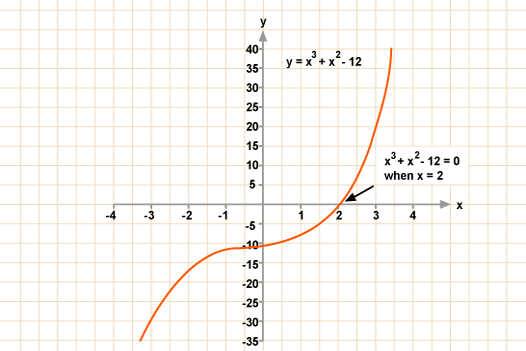
This only shows that lottery tickets might not have a negative expected value in utility terms (as they are certainly negative in dollar terms). You’re not going to the corner store to buy expected value, though, whether it’s a small positive number or a small negative number. No, for a week, you get to imagine a life-changing possibility and aspire to get there, hopefully inspiring you to achieve greater things. You’re not buying a ticket for the lottery, you’re buying a ticket to hope. And that is something we can’t quantify. Whatever you dream about during that week is what your heart desires, so start working towards it today.
*Inflation doesn’t count.
 Irrational Minds Think Alike